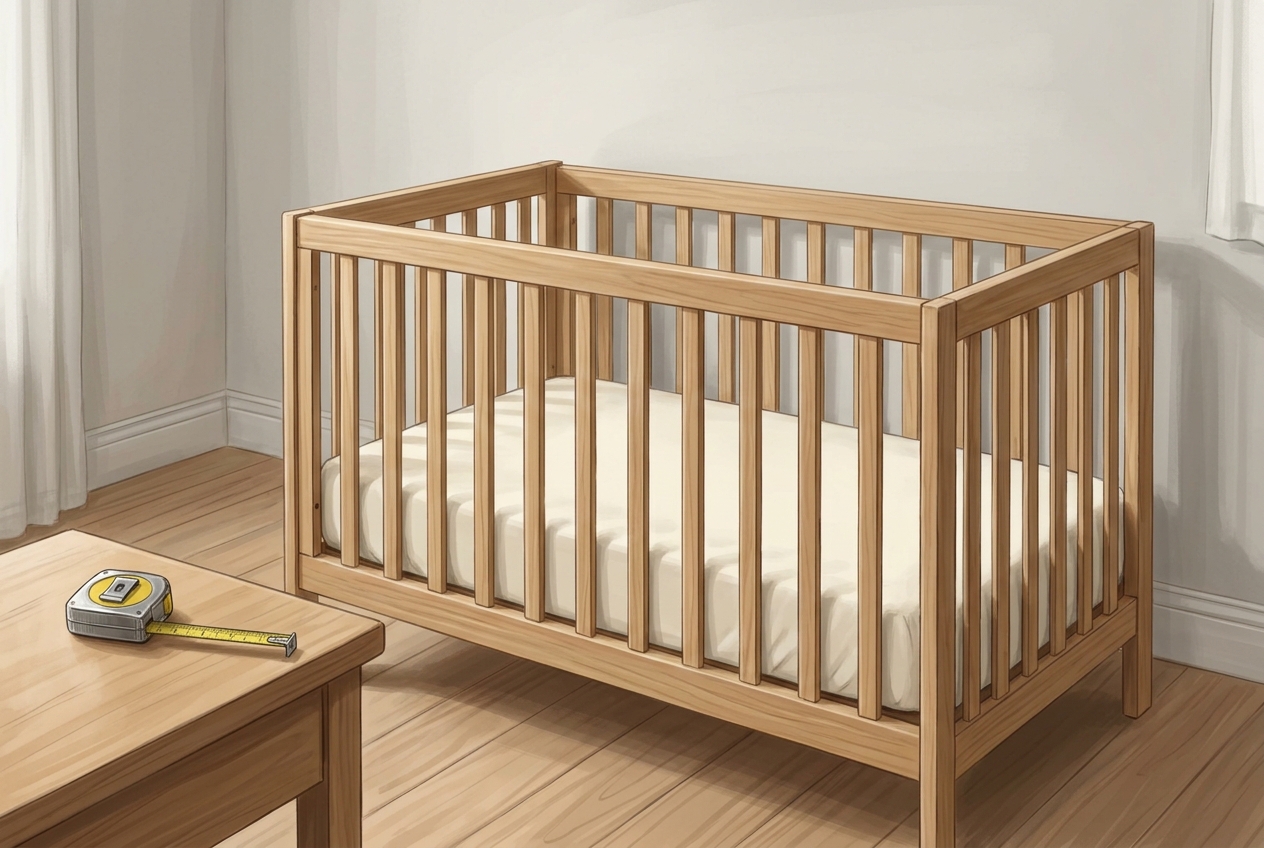
A crib mattress is one nursery purchase where the dimensions and instructions matter more than a long list of premium features. Before comparing foam, springs or washable covers, establish exactly which mattress your crib is designed to accept.
This checklist uses US Consumer Product Safety Commission (CPSC) guidance and manufacturer specifications to help you compare products. Requirements differ between countries, so consult the instructions and applicable standards for the market where you buy your crib.
1. Start with the crib, not the mattress
Find the manufacturer, model number and instruction manual for your crib. Write down the required mattress length, width and maximum thickness. If you are shopping online, compare these details with the actual mattress specifications rather than the product title.
A full-size crib, mini crib and portable play yard are different products. A mattress advertised as suitable for babies is not necessarily suitable for all three. If you cannot identify your crib or obtain its instructions, contact the manufacturer before purchasing a replacement.
2. Check regional sizes before ordering
Even products with the same name can have different dimensions in different countries. IKEA’s KRUMMELUR range provides a useful example:
| Manufacturer listing | Mattress dimensions | Thickness |
|---|---|---|
| IKEA US, item 405.934.05 | 27½ × 52 inches | 3⅛ inches |
| IKEA Japan, item 005.934.07 | 60 × 120 cm | 8 cm |
These are published specifications, not recommendations for a particular crib. The examples show why matching a product name alone is insufficient. Confirm the actual item number and the instructions for your own crib, especially when buying imported products.
3. Understand firmness and mattress construction
The CPSC’s January 2022 announcement of the US crib mattress standard describes testing intended to address excessive softness, poor fit and exposed springs. A mattress should provide a firm, level surface appropriate for infant use.
Foam and spring construction are both available. Rather than assuming one material is safer, compare the documented compliance, dimensions, weight and care instructions of the actual products. A lighter mattress may be easier for an adult to lift when changing sheets, but weight alone says nothing about compliance. Likewise, a thicker mattress is not necessarily a better purchase and must not exceed the crib manufacturer’s permitted thickness.
For a mattress with different infant and toddler surfaces, follow the manufacturer’s instructions for which side to use and when to change sides. Marketing terms such as breathable or premium do not replace fit and firmness requirements.
4. Be especially careful with mini cribs and play yards
The CPSC mattress FAQ advises buyers of aftermarket mattresses to look for compatibility information identifying their particular crib or play yard. Do not add a topper or extra padding to make an existing sleep surface feel more comfortable.
In a July 2, 2026 product warning, the CPSC identified aftermarket mattresses that could leave dangerous spaces in incompatible play yards or mini cribs. The warning illustrates why approximate measurements are not enough to establish compatibility. Prefer the original manufacturer-supplied pad for a play yard; if replacing it, confirm the exact approved replacement with the manufacturer.
5. Compare cleaning features and check the finished setup
Once fit and compliance are established, consider whether the cover is removable, how it can be cleaned, and whether suitable replacement fitted sheets are readily available. Check the manufacturer’s washing and drying instructions before buying. A removable cover can be convenient, but it must be correctly refitted before use.
After installation, inspect the mattress perimeter and make sure the sheet does not pull the corners out of shape. Do not fill gaps with towels or padding. If the mattress does not fit as instructed, stop using it and contact the manufacturer or retailer.
The CPSC’s September 2022 nursery guidance recommends a bare, firm and flat infant sleep surface with a fitted sheet, without pillows, loose blankets or padded bumpers. Place infants on their backs for sleep. Check product recalls before using new or secondhand nursery equipment.
Before you place your order
- Record the crib model and required mattress dimensions.
- Confirm the mattress item number and applicable safety standard.
- Check specific compatibility for a mini crib or play yard.
- Compare cleaning instructions and correctly sized fitted sheets.
- Check the return policy and recall information.
A straightforward mattress with documented compatibility is a more useful purchase than an expensive model whose fit is uncertain. No mattress feature guarantees safety, and this guide does not replace the instructions supplied with your nursery equipment.
For another nursery shopping decision, see our comparison of Wi-Fi and non-Wi-Fi baby monitors.